Mastic Gum: What does the science Say? A dietitian’s Greco Gum review + 10% discount code
- Supplements

If you’ve spent any time looking into natural chewing gum, you’ve probably come across mastic gum. It’s become increasingly popular, with claims ranging from fresher breath and better oral health to improved digestion and even a more defined jawline.
But as a gastrointestinal dietitian, I’m more interested in what the science actually says than what happens to be trending online.
Recently, I’ve been speaking about the connection between oral health, nutrition and gut health, and it’s an area I find fascinating. We often think about the mouth and gut as separate parts of the body, when actually they’re connected in more ways than we might realise.
So, when I came across Greco Gum, a brand producing natural mastic chewing gum, I wanted to explore the evidence behind it. In this review, I’ll explain what mastic gum is, what the research tells us about its potential benefits, and why it could be a useful low FODMAP chewing gum option.
What is mastic gum?
Mastic gum is a natural resin obtained from the mastic tree (Pistacia lentiscus), particularly the variety grown on the Greek island of Chios.
Unlike conventional chewing gum, which usually contains a manufactured gum base alongside sweeteners and flavourings, traditional Chios mastic gum can be chewed in its natural resin form.
It’s actually been used for centuries, so despite its recent popularity on social media, this certainly isn’t a new product.
The resin initially has a firm texture before gradually becoming more pliable as you chew it. Its flavour is naturally quite distinctive, with a slightly pine-like taste rather than the sweetness you might expect from regular chewing gum.
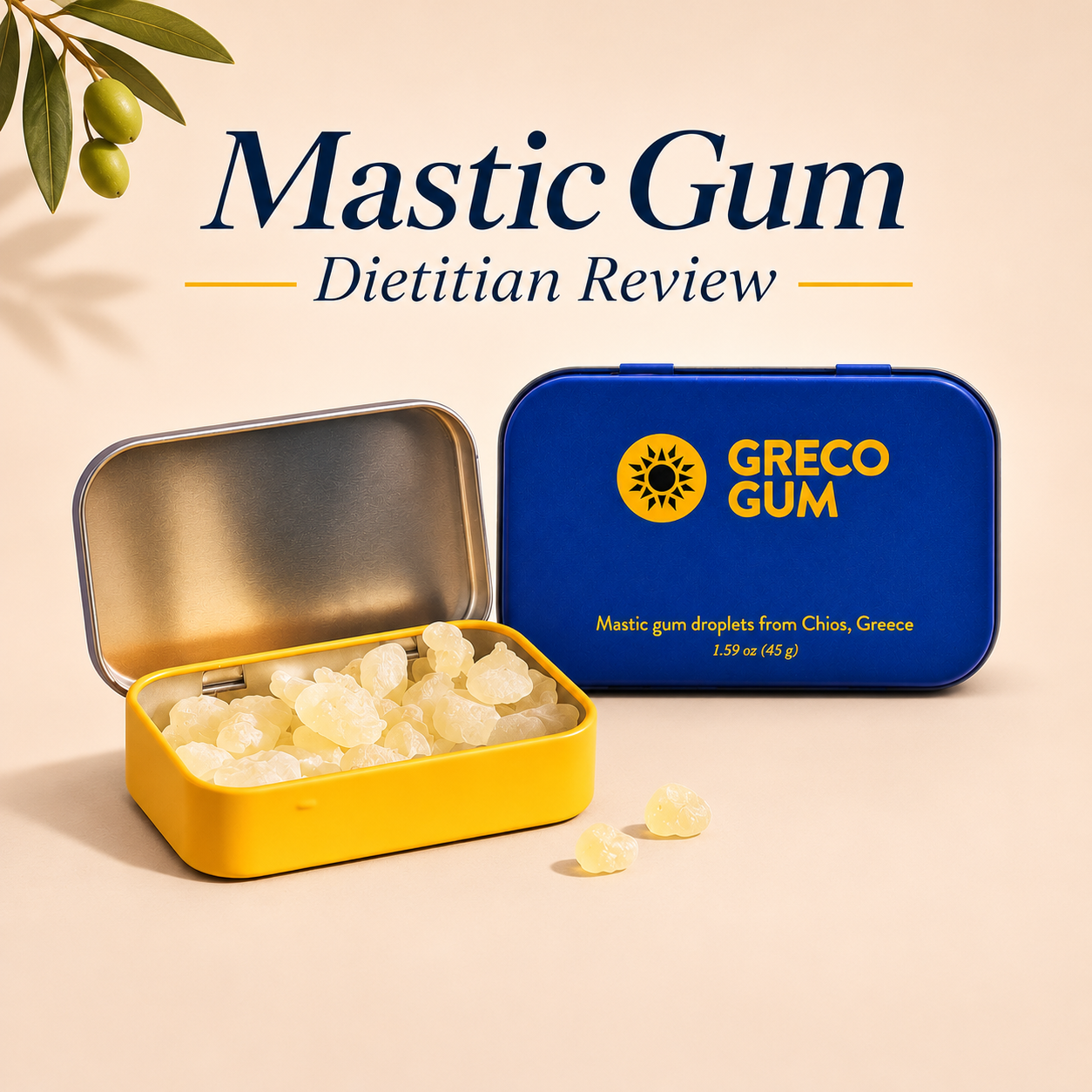
Greco Gum is one brand selling this traditional mastic resin. Its pure mastic chewing gum contains just one ingredient: Chios mastic resin, with no added sugar, artificial sweeteners or flavourings.
That simplicity is one of the reasons I think it’s an interesting alternative to conventional chewing gums, particularly when considering ingredients that may be relevant to digestive symptoms.
What are the benefits of chewing mastic gum?
Before looking specifically at mastic gum, it’s worth understanding that chewing gum itself has some potential oral health benefits, regardless of whether it’s made from mastic resin.
1. Chewing gum stimulates saliva production
One of the clearest benefits of chewing gum is its ability to stimulate saliva.
Saliva does considerably more than keep your mouth moist. It plays an important role in oral health by helping wash away food particles, neutralise acids and protect tooth enamel.
The American Dental Association explains that chewing gum after eating can increase saliva flow, helping to dilute and neutralise acids produced by bacteria in dental plaque (1).
This is particularly relevant after meals, when acid exposure can contribute to damage to the teeth.
Of course, these benefits aren’t unique to mastic gum. Other suitable sugar-free chewing gums can also stimulate saliva production.
Nevertheless, the fact that mastic gum contains no added sugar makes it an interesting option for people looking for a more traditional chewing gum.
2. Mastic chewing gum and oral bacteria: What does the research show?
This is where the research becomes particularly interesting.
Mastic resin contains naturally occurring compounds that have been investigated for antimicrobial activity. However, it’s important to distinguish laboratory findings from studies examining what happens when people actually chew mastic gum.
One small study, published in the Journal of Periodontology in 2003, investigated the effects of chewing mastic gum on oral bacteria, plaque formation and gum inflammation.
Researchers carried out two randomised investigations involving healthy dental students. Compared with a placebo gum, mastic chewing gum was associated with reduced bacterial colony counts in saliva. In a separate seven-day experiment, researchers also observed lower plaque and gingival inflammation scores (2).
These findings are promising, but there are some important limitations. The study involved a small number of participants and followed them for a relatively short period.
Another clinical study, published in 2006, investigated the effects of mastic chewing gum on Streptococcus mutans, a type of bacteria associated with dental decay.
The study involved 25 healthy volunteers and found significantly lower levels of these bacteria in saliva after chewing mastic gum compared with a placebo gum (3).
Again, this is interesting, but reducing bacterial counts over a short period is not the same as demonstrating a long-term reduction in tooth decay or gum disease.
My interpretation? There is some preliminary evidence that mastic chewing gum may have additional oral-health-related properties beyond the mechanical benefits of chewing itself. However, larger and longer clinical trials are needed before we can draw firm conclusions about its effects on dental health.
Importantly, chewing gum should never replace brushing twice daily with fluoride toothpaste, cleaning between your teeth and regular dental care.
What about the connection between oral health and gut health?
As a gastrointestinal dietitian, this is one of the areas I find particularly fascinating.
There is growing scientific interest in something called the oral–gut axis, which describes the potential interactions between the microorganisms living in our mouths and those living within our gastrointestinal tract.
Our mouths contain a complex community of microorganisms, collectively known as the oral microbiome. We also swallow saliva throughout the day, meaning that oral microorganisms can enter the digestive tract.
A 2024 review published in Nature Reviews Microbiology explored how the oral and gut microbiomes may interact and influence one another. The researchers highlighted that oral microorganisms can sometimes reach and colonise the gastrointestinal tract, although many of the underlying mechanisms are still being investigated (4).
This is an exciting area of research, but I think it’s important not to get carried away with what it means in practice.
It doesn’t mean that chewing mastic gum will improve your gut microbiome or treat digestive symptoms. We simply don’t have sufficient clinical evidence to support those conclusions.
What it does highlight is that oral health deserves attention as part of our wider approach to health, including gastrointestinal health.
For me, the practical message is that looking after your teeth and gums matters. Chewing gum may have a place alongside good oral hygiene, but it certainly isn’t a shortcut to better gut health.
Is mastic gum low FODMAP?
If you have IBS, you may have noticed that certain chewing gums leave you feeling bloated or uncomfortable.
This is because many conventional sugar-free chewing gums contain sweeteners known as polyols, which are a type of FODMAP.
Common examples include sorbitol, mannitol, maltitol and xylitol.
These sweeteners can be poorly absorbed in the small intestine. Depending on the type, amount and an individual’s sensitivity, they may contribute to increased water in the intestine, gas production and digestive symptoms.
Monash University specifically highlights polyol-containing chewing gums as something to consider when following a low FODMAP diet (5).
This doesn’t mean that everyone with IBS needs to avoid sugar-free chewing gum, but it’s certainly worth considering if you regularly experience symptoms after chewing it.
Is Greco Gum a low FODMAP chewing gum option?
Yes, based on its ingredients, pure Greco mastic chewing gum is a suitable low FODMAP option.
Unlike many conventional sugar-free chewing gums, it contains no added polyol sweeteners such as sorbitol, mannitol or xylitol.
Instead, the pure mastic gum is made from Chios mastic resin, meaning that it doesn’t contain the sweeteners that commonly cause issues for people following a low FODMAP diet.
This is particularly useful if you enjoy chewing gum but have previously found that sugar-free varieties make your bloating or digestive symptoms worse.
However, there is one other thing worth considering. Some people with IBS find that chewing gum increases their symptoms because they swallow additional air while chewing.
So, even when choosing a low FODMAP chewing gum, it’s still important to consider your individual tolerance.
My Greco Gum review: Is it worth trying?
When reviewing a product, I always look at three things: the ingredients, what the research supports and whether it offers anything genuinely useful.
With Greco Gum, I like the simplicity of the ingredient list. Pure mastic resin offers a different option from conventional sweetened chewing gum, without the added polyols that can be problematic for some people with IBS.
I also think the research around mastic chewing gum and oral health is interesting, particularly the small clinical studies investigating oral bacteria and plaque. However, I’d be cautious about interpreting this as proof of long-term dental benefits.
There are a couple of practical considerations too. Mastic gum is firmer than typical chewing gum, so it may not suit everyone, particularly people with jaw discomfort, temporomandibular joint problems or certain dental restorations.
And while you may see mastic products promoted for digestive health, I wouldn’t recommend chewing mastic gum as a treatment for IBS, bloating or other gastrointestinal conditions. The clinical evidence simply isn’t strong enough for that.
My verdict as a gastrointestinal dietitian
I think Greco Gum is an interesting option for someone looking for a natural, unsweetened chewing gum, especially if they prefer to avoid the polyol sweeteners commonly found in conventional sugar-free gum.
There is some encouraging preliminary research concerning mastic chewing gum and oral bacteria, although we need more robust studies to understand whether these findings translate into meaningful long-term oral health benefits.
For people with IBS, the low FODMAP ingredients are a practical advantage worth considering, but individual tolerance remains important.
Would I consider it an essential product for gut health? No. But as an alternative to conventional chewing gum, I can see why people might be interested in trying it.
Greco Gum discount code: Get 10% off with KIRSTEN10
If you’d like to try Greco Gum for yourself, you can use my discount code to save 10% on your purchase.
Greco Gum discount code: KIRSTEN10
Discount: 10% off
Shop Greco Gum and use code KIRSTEN10
Greco Gum offers different sizes and textures of natural mastic chewing resin. If you’re new to mastic gum, you may prefer starting with its softer nuggets rather than the firmer droplets.
Affiliate disclosure: This article contains an affiliate link, which means I may earn a commission if you purchase through it, at no additional cost to you.
Frequently asked questions about mastic gum
Is mastic gum good for gut health?
There is scientific interest in mastic resin and digestive health, but much of that research examines preparations that are swallowed rather than the act of chewing mastic gum. We don’t currently have sufficient evidence to recommend chewing mastic gum to improve gut health or manage gastrointestinal conditions.
Is Greco Gum low FODMAP?
Yes, Greco Gum’s pure mastic chewing gum is a low FODMAP option based on its ingredients. It contains no added polyol sweeteners such as sorbitol or mannitol, which are commonly found in conventional sugar-free chewing gums.
Is mastic gum better than regular chewing gum?
That depends on what you’re looking for. Mastic gum has a simple ingredient list, and some small studies have investigated its effects on oral bacteria and plaque. However, there isn’t sufficient evidence to conclude that it is generally superior to other sugar-free chewing gums for dental health.
Can chewing gum make IBS bloating worse?
For some people, yes. Certain sugar-free chewing gums contain polyols that may contribute to digestive symptoms. Swallowing air while chewing may also contribute to bloating in susceptible individuals. Not everyone with IBS experiences these effects.
Does mastic gum help with bad breath?
Chewing gum stimulates saliva, which can help keep the mouth moist. Early research into mastic resin has also explored its effects on oral bacteria. However, there is insufficient evidence to guarantee that mastic gum provides sustained relief from bad breath. Persistent bad breath should be assessed by a dentist.
What is the Greco Gum discount code?
You can use KIRSTEN10 for 10% off Greco Gum through my Greco Gum link.
References
- American Dental Association. Chewing Gum. Read guidance.
- Takahashi K, et al. (2003). A pilot study on antiplaque effects of mastic chewing gum in the oral cavity. Journal of Periodontology, 74(4), 501–505. Read study.
- Aksoy A, Duran N, Koksal F. (2006). In vitro and in vivo antimicrobial effects of mastic chewing gum against Streptococcus mutans and mutans streptococci. Archives of Oral Biology, 51(6), 476–481. Read study.
- Kunath BJ, et al. (2024). The oral–gut microbiome axis in health and disease. Nature Reviews Microbiology, 22, 791–805. Read review.
- Monash University. Update: Label reading and FODMAPs. Read guidance.