How to Increase Fiber Without Bloating: A Dietitian’s Guide
- Supplements

How to Increase Fiber Without Bloating: A Dietitian’s Guide
Fiber is having a bit of a moment. “Fiber maxxing” is all over social media and, as a gut specialist dietitian, I am very happy that people are finally talking about a nutrient that most of us don’t get enough of.
But there is a catch. If you suddenly increase your fiber intake because you’ve heard you should be getting 30g or more a day, you may find yourself feeling much more bloated. This is something I see all the time in my clinic.
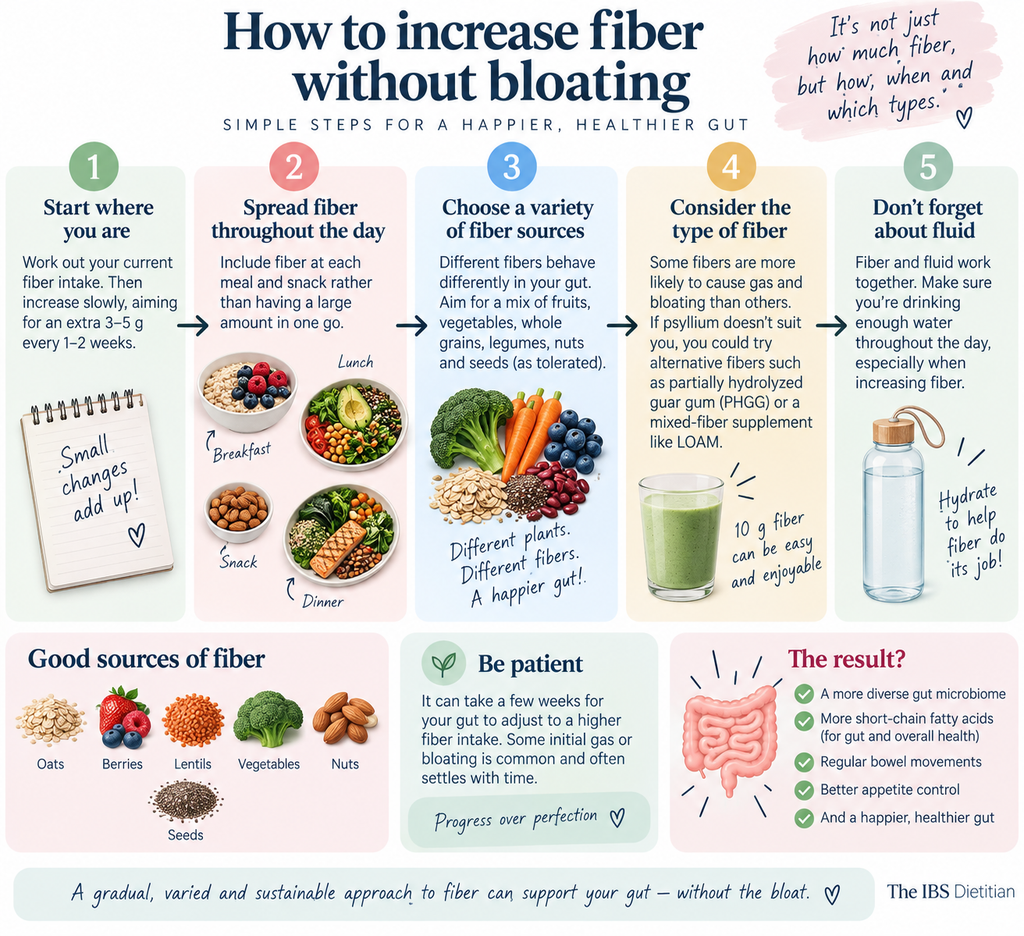
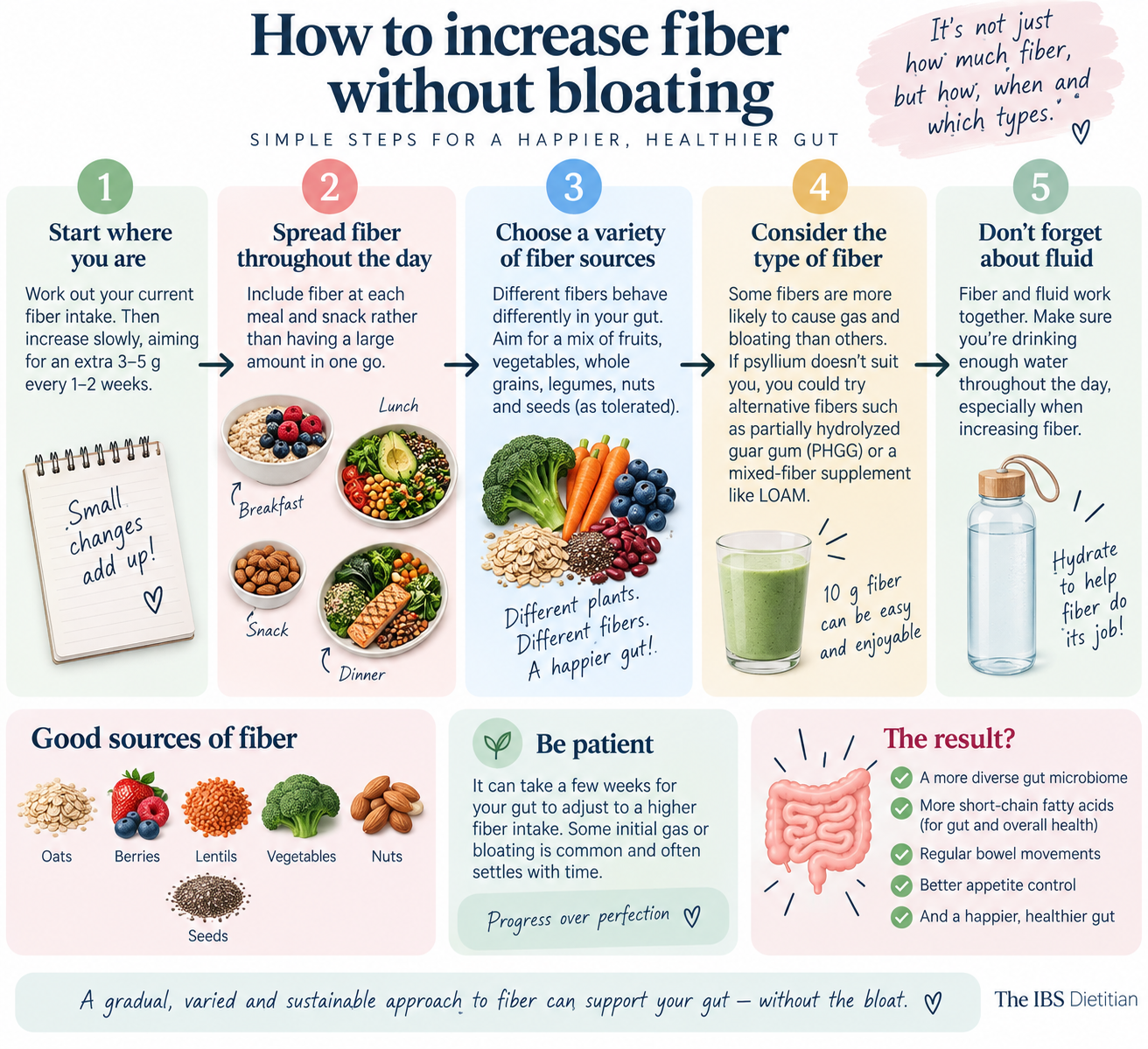
The good news is that you don’t necessarily need to eat less fiber. Learning how to increase fiber without bloating is usually about how quickly you increase it, how much you eat at one time, your fluid intake and what your bowels are doing.
How much fiber should you eat each day?
In the UK, adults are advised to eat 30g of fiber per day by the Scientific Advisory Committee on Nutrition (SACN).1
Yet most of us aren’t getting anywhere close. The latest National Diet and Nutrition Survey found that adults aged 19–64 were eating an average of just 16.4g of fiber per day, with only 4% meeting the recommendation.2
There are good reasons to increase your fiber intake. Higher fiber intakes are associated with a reduced risk of cardiovascular disease, type 2 diabetes and colorectal cancer, as well as supporting bowel health and helping with weight management.3
But going from 15g to 30g overnight isn’t necessarily the best way to get there.
Why does fiber cause bloating?
When someone tells me “fiber makes me bloated”, my first question isn’t usually which food do we need to remove? I want to work out why the bloating is happening.
There are several reasons increasing fiber can cause bloating, and once you know which one is relevant to you, it becomes much easier to make practical changes.
Your gut bacteria ferment fiber and produce gas
We can’t completely digest certain types of fiber ourselves. Instead, they travel through the digestive tract until they reach the large bowel, where our gut bacteria ferment them.
This is actually a good thing. Fermentation produces beneficial compounds including short-chain fatty acids, but it can also produce gas. If you suddenly provide your gut bacteria with much more fermentable material than they’re used to, you may notice more gas and bloating.
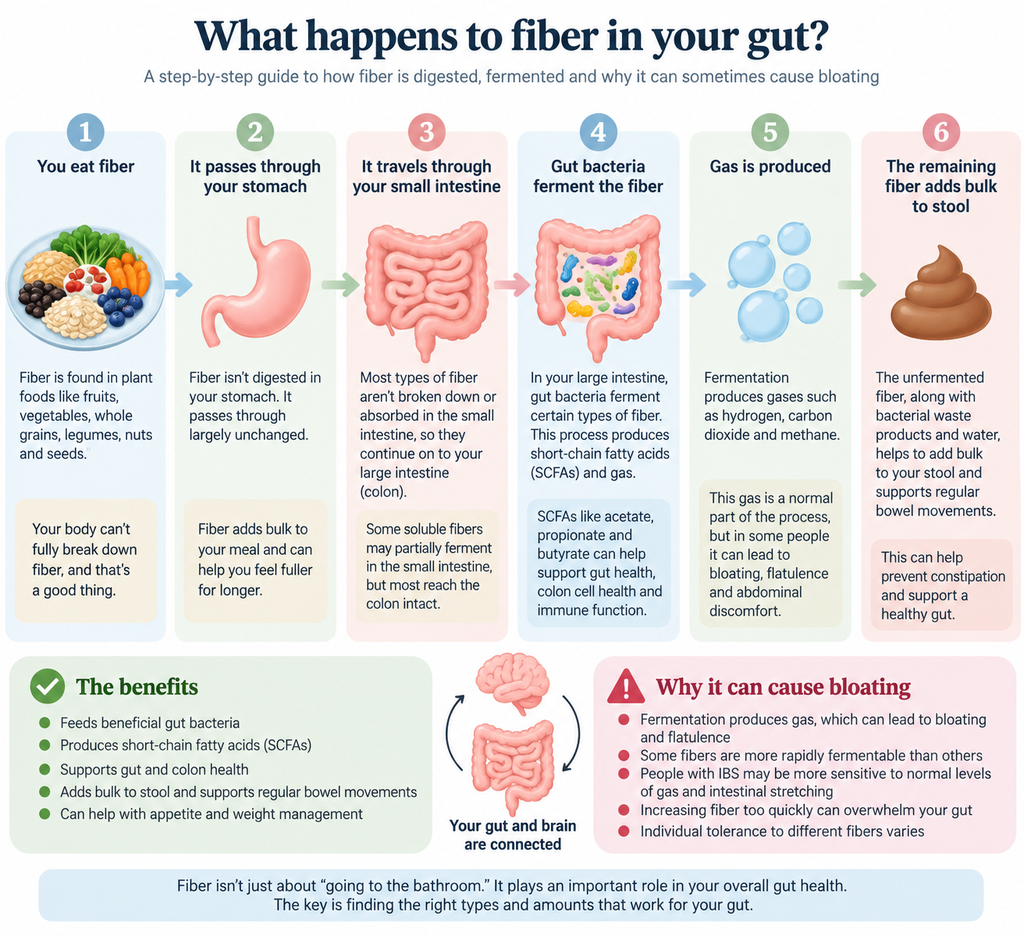
Fiber → small intestine → large bowel → gut bacteria ferment fiber → short-chain fatty acids + gas
This is why feeling more bloated when you first increase fiber doesn’t automatically mean that fiber is “bad for your gut”. It may simply mean you’ve increased it too quickly.
Some fiber can make you feel fuller for longer
Different fibers behave differently inside the digestive tract. Some soluble fibers absorb water and increase the viscosity of the contents of your gut, which can influence gastric emptying and help you feel fuller after eating.4
That’s one of the useful properties of fiber, particularly when we think about appetite and weight management. But suddenly adding a large amount to a meal can also leave some people feeling uncomfortably full.
You increased your fiber but forgot about fluid
This is one of the first things I check with my clients. Someone proudly tells me they’ve doubled their fiber intake, but their fluid intake hasn’t changed at all.
Fiber and fluid need to work together. If stools become harder and more difficult to pass, constipation can develop or worsen — and constipation itself is one of the most common reasons I see people struggling with bloating.
So before deciding you need to reduce fiber again, look at your bowel movements. Are your stools harder? Are you straining? Are you going less frequently or feeling as though you haven’t completely emptied your bowels?
How to increase fiber without bloating: don’t eat it all at once
One of my biggest tips for increasing fiber without bloating is to spread your fiber throughout the day.
I often see people eating relatively little fiber at breakfast and lunch and then trying to make up for it with an enormous high-fiber evening meal. They may technically hit their 30g target, but their gut has received a huge fiber load all at once.
For example:
[
| Spread throughout the day | Fiber-loaded evening |
| Breakfast: 7g | Breakfast: 3g |
| Lunch: 8g | Lunch: 4g |
| Snack: 5g | Snack: 3g |
| Dinner: 10g | Dinner: 20g |
| Total: 30g | Total: 30g |
Both people have eaten 30g of fiber, but that doesn’t mean their digestive experience will necessarily be the same.
When I’m working with clients, I therefore don’t just ask “How much fiber are you eating?” I look at where that fiber is coming from across the day.
Increase your fiber slowly
If you want to increase fiber without bloating, this is probably the most important thing I can tell you: don’t try to double your intake overnight.
I sometimes compare this to going to the gym. You wouldn’t walk into a gym for the first time and immediately pick up the heaviest weights. You build up gradually, and I want you to take a similar approach with your gut.
If you’re currently eating around 15g of fiber, you don’t necessarily need to aim for 30g tomorrow. Your first target might be 18g, then 20g and gradually upwards depending on how your gut responds.
I use SMART goals with my clients for exactly this reason. Rather than telling someone vaguely to “eat more fiber”, we set a specific, measurable and realistic change and then review what happens.
There is no prize for reaching 30g in the shortest possible time.
Rule out constipation if increasing fiber makes you bloated
If you have increased your fiber and your bloating has become worse, check for constipation before blaming the fiber itself.
This isn’t always as obvious as not opening your bowels for several days. You can open your bowels regularly and still experience hard stools, straining, incomplete evacuation or difficulty passing stool.
Adding more and more fiber isn’t always the answer either. If significant constipation is already present, particularly where there may be an evacuation disorder, I would want that properly assessed rather than simply continuing to increase fiber.
Can a fiber supplement help you increase fiber without bloating?
I generally take a food-first approach because fiber-containing foods provide much more than fiber alone. However, real life isn’t perfect and there can absolutely be a place for a fiber supplement.
This is where I think supplements can be particularly useful: filling an identified fiber gap, rather than automatically adding another 10g of fiber on top of whatever you’re already eating.
One option I’ve been using is LOAM, which provides 10g of fiber in a full serving. The original formulation combines six different fibers, including partially hydrolyzed guar gum (PHGG), tapioca fiber, soluble wheat fiber, soluble corn fiber, xylooligosaccharides (XOS) and soluble carrot fiber.5
LOAM has deliberately selected fibers with different fermentation characteristics, with the idea that they are fermented at different rates and points through the colon rather than providing one large fermentation load at once.5
I find this particularly interesting when we’re talking about increasing fiber without bloating, because fermentation rate can influence gas production. However, this doesn’t mean that LOAM has been clinically proven to prevent bloating, and individual tolerance will always vary.
I’ve gone much deeper into the individual ingredients and research in my full dietitian review of LOAM.
Do you need to take a fiber supplement every day?
No – and this is something I think gets missed in the supplement conversation.
If you’re currently getting 15g of fiber from food, adding another 10g is very different from someone already getting 30g adding another 10g on top. I prefer to track first and supplement second.
I also don’t think you necessarily have to use LOAM every single day. Depending on your usual fiber intake, you may find it more useful on the days when your diet happens to be lower in fiber.
One of my favorite practical options is actually the LOAM sachets. I can put one in my handbag and, if I’m eating out and realize my meal is going to be pretty low in fiber, I can have it in a glass of water alongside the meal.
That feels much more realistic to me than expecting every single meal you eat to perfectly meet your nutritional targets.
How do you know if you’re increasing fiber too quickly?
Your gut is actually pretty good at giving you feedback.
If you’ve increased your fiber and suddenly have substantially more bloating, gas, abdominal discomfort or changes to your bowel movements, don’t immediately conclude that you “can’t tolerate fiber”.
Look at what changed and how quickly. I will often take someone back a step, let things settle and then increase more gradually rather than abandoning the goal altogether.
This is another reason I encourage people to track their fiber intake for a short period. You don’t need to count every gram of fiber for the rest of your life, but doing it temporarily can show you whether you’re eating 12g, 22g or 35g – and where you’re suddenly getting big fiber loads.
What if you’re eating more fiber but still feel very bloated?
This is where things become particularly interesting in IBS because how bloated you feel isn’t determined solely by how much gas is inside your gut.
People with IBS can experience visceral hypersensitivity, where normal changes and sensations within the digestive tract are perceived much more intensely.6
I once worked with a client who described her bloating as severe. When we explored it more closely, the actual visible change in her abdomen was relatively small and within the sort of change we would expect after eating — but to her, the sensation felt enormous.
That completely changes the way I approach the problem. If hypersensitivity is driving the severity of the bloating, continually cutting out foods or trying to reduce fiber further isn’t necessarily addressing what is going on.
Remember: some bloating is completely normal
This is probably one of the most reassuring things I tell people in clinic: your stomach isn’t supposed to look exactly the same at 7am and 7pm.
You have eaten food, drunk fluid and your digestive system has been processing it all day. A degree of fullness after eating and some increase in abdominal size as the day progresses can be completely normal.
Bloating refers to the sensation of abdominal fullness or pressure, while distension describes a measurable increase in abdominal girth. You can experience one without necessarily experiencing the other.6
The goal when increasing fiber isn’t to maintain a perfectly flat stomach. It’s to increase your fiber intake in a way that supports your long-term health without leaving you unnecessarily uncomfortable.
My 6 tips for increasing fiber without bloating
1. Work out how much fiber you’re currently eating. Don’t automatically add another 10g if you don’t know your starting point.
2. Increase fiber gradually. Your gut needs time to adjust, particularly if your usual diet has been relatively low in fiber.
3. Spread fiber across your day. Don’t eat very little all day and then try to hit your entire target at dinner.
4. Drink enough fluid. Particularly if your increased fiber intake is making your stools harder or more difficult to pass.
5. Check for constipation. If you’re bloated and constipated, continually adding more fiber may not be the right solution.
6. Use fiber supplements strategically. Think about them as one tool for filling your fiber gap rather than something everybody automatically needs every day.
Frequently asked questions about increasing fiber without bloating
Increase your fiber gradually rather than making a sudden jump, spread fiber across your meals, drink adequate fluid and monitor your bowel movements. If you’re already constipated, address this rather than simply continuing to add more fiber.
Certain fibers are fermented by your gut bacteria, which produces gas. A sudden increase in fiber can therefore cause more gas and bloating while your digestive system adjusts.
There isn’t one schedule that will suit everybody. I prefer to establish someone’s current intake first and then make small, achievable increases while monitoring bloating and bowel symptoms.
Bloating caused by suddenly increasing fiber may improve as your gut adapts, particularly if you slow the increase and distribute your fiber throughout the day. Persistent or severe bloating shouldn’t simply be assumed to be caused by fiber.
Yes. Eating a large amount of fiber – particularly when your usual intake is much lower – can increase fermentation, gas and feelings of fullness. More fiber isn’t automatically better.
Yes. Eating a large amount of fiber – particularly when your usual intake is much lower – can increase fermentation, gas and feelings of fullness. More fiber isn’t automatically better.
Adequate fluid is particularly important when increasing fiber because some fibers interact with water and influence stool consistency. If increasing fiber has contributed to harder stools or constipation, reviewing your fluid intake is important.
Not automatically. Fiber has important long-term health benefits, so I would first look at how much you’re eating, how quickly you increased it, how it’s distributed across your day, your fluid intake and whether constipation is contributing to your symptoms.
Fiber supplements can be useful for filling a gap, but I don’t view them as a replacement for a fiber-rich diet. I prefer to work out approximately how much fiber someone is getting from food first and then decide whether supplementation would actually be useful.
The bottom line
If you’re trying to work out how to increase fiber without bloating, don’t make the mistake of thinking the solution is simply eating as much fiber as possible.
Start with where you are now, increase gradually, spread your fiber across the day, make sure you’re drinking enough and pay attention to what your bowels are doing.
After 15 years of working with people with IBS and digestive symptoms, one thing I have learned is that the “perfect” fiber intake on paper isn’t particularly helpful if someone feels miserable trying to achieve it.
The aim isn’t to fiber-max your diet. It’s to find a way of getting enough fiber to support your long-term health that your gut can actually live with.
Book a free enquiry call
You might also like...
Can Gas X (Simethicone) Help with IBS? A Dietitian Explains