LOAM prebiotic fiber – dietitian review (20% discount code)
- Uncategorised

Introduction
If you struggle with debilitating gut issues or find it difficult to reach your fibre needs, you would probably want to know if LOAM prebiotic fibre could help you.
We have deep dived into this new product to check what the science says about it and ultimately if it is actually good for you or not.
please note that this article contains an affiliate discount code – this means I will earn a small commision if you buy using the code or link.
GET 20% OFF LOAM – USE CODE ‘THEIBSDIETITIAN20‘
What is LOAM?
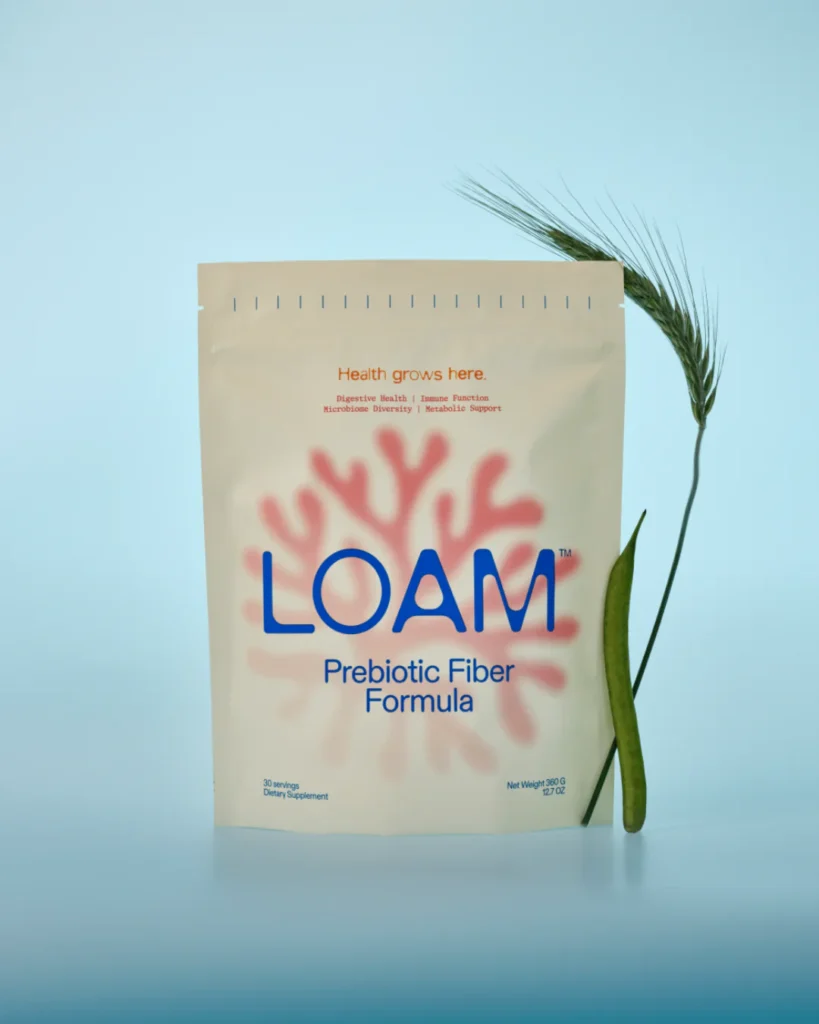
LOAM is a prebiotic fibre supplement founded by Dr. Karan Rajan. LOAM contains six different fibre sources, including (1):
- Partially hydrolyzed guar gum (PHGG)
- Tapioca fiber
- Soluble wheat fiber
- Soluble corn fiber
- Xylooligosaccharide
- Soluble carrot fiber
LOAM contains 10g of dietary fiber, which is one-third of the daily recommended intake for the general population (2).
This prebiotic supplement comes in powder form, and when dissolved in water, it has no taste or texture (1).
What is a prebiotic?
Prebiotics are compounds that feed the beneficial microbes in our gut, helping them grow and support our health (3).
Each prebiotic nourishes specific gut microbes, and different prebiotics support different microbes. Because of this, using more than one prebiotic can help a wider range of microbes grow, leading to greater microbial diversity (4, 5, 6).
Higher microbial diversity is linked to a more balanced microbiota and better overall health (7).
Is LOAM good for gut health?
LOAM can help you reach the recommended daily intake of dietary fibre more easily because it provides one-third of the daily recommendation.
Research shows that average fibre intake is much lower than recommended—about 18 g per day in the UK and even lower in the USA, at roughly 16 g (9, 10).
Sufficient dietary fibre is crucial for:
- Regularity and consistency of the stools
- Balanced gut microbiota
- Maintaining a healthy gut lining
- Reducing risk for diverticular disease and colorectal cancer
I always advocate for a food-first approach. However, some people find it difficult to reach sufficient fibre intake with diet alone.
For those who struggle to get enough dietary fiber consistently, LOAM is a convenient option.
In addition to boosting fibre intake, specific prebiotic fibers from LOAM—PHGG, xylooligosaccharide, and rhamnogalacturonan-I—have been shown in the research to support the growth of beneficial gut bacteria, such as Bifidobacteria (11, 12, 13).
When gut microbiota ferment prebiotics, they produce short-chain fatty acids (SCFAs). SCFAs play an important role in gut and overall health by (14, 15):
- Nourishing colon cells
- Supporting gut barrier health
- Helping regulate metabolism
- Helping regulate immune function
What are the other potential health benefits of LOAM?
LOAM has recently reported preliminary findings from its first human trial, known as the GRASP study (21).
This 30-day, double-blind, placebo-controlled trial compared two different doses of LOAM with a placebo. According to results reported by LOAM, microbiome sequencing from 47 participants showed that the overall composition of the gut microbiota differed between participants taking LOAM and those taking the placebo.
LOAM also reported enrichment of several groups of bacteria involved in fibre fermentation and short-chain fatty acid production, including Roseburia, Prevotella and Parabacteroides. Roseburia includes bacteria that produce butyrate, a short-chain fatty acid that provides energy for cells lining the colon and supports the gut barrier.
However, these findings need to be interpreted cautiously. The study is registered on ClinicalTrials.gov, but the full results have not yet been published in a peer-reviewed journal. The trial registry describes a planned sample of approximately 90 healthy adults, while LOAM’s preliminary findings are based on 47 participants. Full information about participant withdrawals, the size of the changes and all the measured outcomes is not yet publicly available.
The study also involved healthy adults rather than people with IBS. It shows that LOAM may influence the composition of the gut microbiota, but it does not currently demonstrate that LOAM improves IBS symptoms, bowel habits, immune function or metabolic health.
One of the ingredients of LOAM is partially hydrolyzed guar gum (PHGG). A 2022 study found that 12 weeks of daily PHGG intake reduced cold-like symptoms in healthy adults compared with the control group (16).
The same study also showed higher fecal short-chain fatty acids and changes in immune markers, suggesting PHGG may influence immune function (16).
LOAM also contains a carrot-derived prebiotic called rhamnogalacturonan-I. In one study on this compound, participants who took 0.3 g/day cleared the virus faster compared to the control group. Symptoms improved 28 % sooner—about 4.7 days versus 6.5 days with placebo (17).
However, we do not know how much of these ingredients are in the LOAM as there is no breakdown available. This means the product may not be comparable to these research.
LOAM contains soluble fibres, which means they (18, 19):
- Dissolve in water
- Form a gel-like substance in your gut
- Slow digestion
- Help regulate blood sugar
- Can lower cholesterol
Is LOAM recommended for people with IBS?
Although the GRASP study provides some preliminary evidence that LOAM can alter the gut microbiota, it did not study people with IBS. The findings therefore cannot tell us whether LOAM reduces IBS symptoms such as pain, bloating, constipation or diarrhoea. Evidence relating specifically to IBS currently comes from research on some of LOAM’s individual ingredients rather than the complete formula.ffects of dietary fibre are beyond regular bowel movements.
LOAM is designed to be low FODMAP, so it can be suitable for people with IBS, according to the manufacturer (1). This means it could help you achieve high fibre intake without causing you IBS symptoms.
LOAM contains six different prebiotics, which makes it better tolerated as the fermentation is steadier throughout the colon – prebiotics ferment at different paces and places in the colon (depending on the solubility and the length of the molecule) (8).
But so far, it has not been tested by the authority on FODMAP testing, Monash University. Therefore, introduce LOAM slowly and gradually.
We often recommend psyllium husk to manage constipation and diarrhea for our clients with IBS. However, the additional prebiotics contained in LOAM may offer other benefits, given the variety.
Partially hydrolyzed guar gum, one of the prebiotics from LOAM, has been shown to improve bloating and gassiness in people with IBS when taking 6 g/day (20).
However, the manufacturer of LOAM does not disclose the exact quantities of the individual ingredients, only the serving size, which is 12 g, and PHGG is just a part of that. Lack of data limits direct comparison with the doses used in clinical studies.
In addition, the 2023 Japan Gastroenterological Association clinical guidelines report that PHGG increases bowel movement frequency in individuals with chronic constipation (21).
Overall, these findings indicate that PHGG is a well-supported prebiotic fiber with documented benefits for both IBS-related symptoms and constipation. But as the dosages in LOAM are not publicly available, we can not confidently extrapolate these research findings to the product itself.
LOAM DISCOUNT CODE (20% OFF) ‘THEIBSDIETITIAN20’
Is LOAM gluten-free and vegan?
Yes, LOAM is certified gluten-free and vegan (1).
According to the manufacturer, it is also free from (1):
- Soy
- Tree nuts
- Peanuts
LOAM is certified gluten-free, but it contains wheat (gluten removed) and therefore is not appropriate for people with wheat allergy.
LOAM also does not contain (1):
- Artificial sweeteners
- Sugar alcohols
- Added sugars
- Preservatives
- Fillers
How do you take LOAM?
Add 1 scoop or sachet to 10–12 fl oz of liquid and stir until dissolved. Let it sit for 60 seconds before drinking.
Start with ½ scoop for 2 days, then increase, so your gut can get used to increased fiber intake (if you are sensitive, start with ½ scoop for 4 days).
I recommend you add LOAM to your smoothie, oats, or soups, as it has no taste and texture.
Stay well hydrated – aim for 30 ml of liquid per kg of body weight per day. If you live in a hot and humid environment, your needs for hydration might be higher.
Good hydration is important as fiber needs water to move through the gut comfortably.
In case you are wondering, there are no known side effects of taking LOAM.
Video showing how to use LOAM and how it compares to psyllium husk
LOAM Wheat Free Version
LOAM has now launched a wheat-free version of its prebiotic fibre formula. The original LOAM is certified gluten-free because its soluble wheat fibre is processed to remove gluten, but it still contains wheat and is therefore unsuitable for anyone with a wheat allergy.
The new wheat-free formula removes the soluble wheat fibre while retaining the other five prebiotic fibres: partially hydrolysed guar gum, tapioca fibre, soluble corn fibre, xylooligosaccharide and soluble carrot fibre. It still provides 10 g of fibre per serving.
If you already tolerate the original LOAM, there is no evidence that you need to switch, as the wheat-free version is not necessarily better. It simply provides an alternative for people who need or prefer to avoid wheat completely.
How do I order LOAM?
You can order LOAM directly on their website. You can choose between a 30-day pouch or single-serve sachets.
They ship to (21):
- USA
- UK
- EU: Austria, Belgium, Czechia, France, Germany, Ireland, Netherlands, Poland, Portugal, Sweden
- Australia
- New Zealand
- Canada
- Singapore
If you order a quarterly subscription (one order contains 90 servings), the international shipping is free (21).
Some Extra Tips for Using LOAM Prebiotic Fiber
Unlike other prebiotic supplements, LOAM dissolves quickly into water with very little taste. This makes it a lot more realistic as a long-term element in your diet compared to similar products in the market which will test your gag reflex.
Although the taste is mild, you can actually add a splash of lemon also which gives it a really neutral taste for anyone who is a little more sensitive to flavour.
Summary
LOAM contains six soluble fibres designed to provide 10 g of fibre per serving and nourish different groups of gut microbes.
Preliminary findings reported by LOAM suggest that the complete formula can alter the composition of the gut microbiota after 30 days. However, the full study has not yet been published in a peer-reviewed journal, and it involved healthy adults rather than people with IBS. We therefore cannot conclude from this research that LOAM improves IBS symptoms or produces wider immune or metabolic benefits.
Some individual fibers in LOAM, particularly PHGG, have evidence supporting their use for certain digestive symptoms. However, LOAM does not disclose the quantity of each fiber, so studies using specific doses of individual ingredients cannot be applied directly to the complete product.
Low fermentable and soluble fibres can help with regularity and consistency of the stools, but if we look beyond gut health, they can help regulate blood glucose and cholesterol.
It is important to introduce fibre supplements slowly, so your gut can adjust.
They ship worldwide, and with a quarterly subscription, the international shipping is free.
Written by Barbara Lešnik, RD, MSc, reviewed by Kirsten Jackson, Consultant Dietitian, BSc Hons, RD, PG Cert
Book a free enquiry call
You might also like...

Kiwi for Constipation: Do You Need to Eat the Skin?

The connection between IBS and neurodivergence